


Motivation
The primary motivation for writing a technical book should not be money. If it is, you should probably reconsider. Technical books have a highly niche audience. With the rise of AI tools, fewer people rely on books for technical answers.
Financial gain was never the motivation for me, so what inspired me to write “System Design on AWS”?
Personal Growth: Taking a complex idea and translating it for beginners forces you to deepen your own understanding.
The Communication Challenge: Having deep technical knowledge is common, but delivering it effectively is rare. Writing the book was a test of communication and documentation skills. I credit much of this to the writing culture at Amazon.
Building Trust: Being an author with a respected publisher like O’Reilly acts as a powerful credential. Much like having a top-tier university or top company on your resume.
Is It Really Worth It?
Absolutely, but the ROI is in your network, not your bank account. As the saying goes, “Your network is your net worth.” Publishing the book opened doors to connect with industry leaders, CTOs, and senior engineers. I’ve been invited to multiple conferences to share my insights so it has been my way of giving back to the community. The connections allow you to learn from other leaders’ failures, successes, and decision-making processes.
Adding to above, it’s not like you’ll make nothing. The idea is not setting high expectations on monetary terms.
Project Initiation
Me and my co-author Jayanth Kumar took close to 2.5 years to finish the project. The details outlined as part of this blog are specific to O’Reilly but it’s similar with other technical publishers as well. I’ll divide the process into multiple phases from initial thought process to hard copies in my hands.
Proposal Submission
Starting out is always hard. Jayanth shared this idea with me and had some details already put up in the proposal. We brainstormed among ourselves on the structure of the book so as readers are hooked to the content throughout.
You can find all the details on the O’Reilly Work With Us page regarding different ways you can contribute.
The Proposal Details
Here is the high level description of what you need to fill in the proposal (make a copy of proposal from here).
Book title and subtitle: The title of the book. For subtitles, you can also suggest multiple subtitles and decide later what works best.
About the Author: This is basically an author biography and why do you feel you’re the best person to write the book on a particular topic. You can include your past work such as your industry experience, previous technical books/blogs/videos, speaking at conferences, etc.
Marketing Description: This is something you find on the back cover of the book. You’re basically pitching to buy the book to a potential reader.
About the topic: This section explains the book title in detail and why it’s important.
Audience: Who will read this book?
What the reader will learn: There is always some end goal if you’re selling a product. If the reader finishes the book, what kind of knowledge gain happens and how/where the reader will apply this knowledge.
Competing titles: If there are similar titles in the market, how this book differs from them and what new values this book specifically offers.
Book outline: Here you include a detailed chapter-wise table of contents.
Schedule: How much time will you take to finish the first two chapters, half manuscript and full manuscript. Keep in mind that life happens and if you’re working on the book writing along with your full-time job then keep a buffer.
Balancing the content takes effort, what you go into the book and what should be skipped is the decision you’ve to make. Be ready to spend so much time on choosing topics to be included as part of the book and then again striking them off because you found other things which are more important. Once the draft was ready, we directly emailed one the Content Acquisition Editors from O’Reilly.
Proposal Submission Timeline
We were hopeful of the proposal approval as we firmly believed this is a unique book and solves a lot of gaps in the content already available in the market. Good things happen if you’re hopeful, and we received a positive response to the proposal. At this point, it’s not 100% approved but the acquisitions editor will work with you to modify some details as needed. For example:
We had a lot of discussion if Part II of the book (AWS specific content) should be included or not. The point being made was there is already a lot of AWS documentation available on the internet, so what new value does the book bring? We finally agreed to keep it so readers can find everything at single place and they are able to follow along from Chapter 1 to Chapter 21. You don’t want to ask the reader to go read on internet about a specific AWS service and then come back to the book on how it’s used practically.
We had 15 chapters in Part III of the book in the initial proposal which was trimmed down to 8 later. As I was saying earlier, you’ll have to balance the content.
TIP: We also wrote one chapter from Part III and shared after proposal submission on how we’re envisioning the content. I later scrapped it off and wrote it from scratch but if you can, it’s a good idea to have some content ready from the chapters.
After all this communications, the proposal was officially approved and we were presented with a contract to sign. Once signed, the actual work started.
Book Writing Process
You’re assigned a development editor to work with you throughout the book after contract signing. In the first meeting, the development editor shares details like:
Writing tool: You can either write in Google Docs or O’Reilly has an in-house tool called Atlas.
Development Schedule: You agree on a chapter-wise schedule on when the chapters will be ready.
Writing Style: Details around illustrations, writing style, content structuring, etc.
Once you finish a chapter, you share the chapter with the development editor. The role of development editor is to share feedback on the first draft. You work on the shared feedback and it becomes a continuous loop for all the chapters.
After development review is done and feedback is addressed, the chapters are published to O’Reilly platform in early release form. The good thing is people can read chapters early and share reviews on the platform. It’s much similar launching a product MVP, gathering feedback and improving on it before the final launch of the product.
In parallel, the book chapters also goes through technical reviews. For technical reviews, O’Reilly has their own reviewers and you can also suggest from your network. The technical reviews are phased into generally 3 parts, first two chapters, then half manuscript and then full manuscript.
After development and technical review completion of the chapter, the next step is the production phase.
Book Production Phase
A production editor walks you through the book production timelines and different stages as part of this process. Here are few things taken care of as part of this phase:
Copy Editing: A copy editor goes through the entire manuscript to make sure it matches the O’Reilly style guidelines. This stage generally doesn’t require too much input from your end. This is divided into two parts, QC1 and QC2. You can suggest anything as part of QC1 and that is addressed as part of QC2.
Illustrations: In parallel to copy editing, an illustrator works through the images and recreates them as per O’Reilly style. You can work through the illustrations for any suggestions from your end.
Index: An indexer is assigned to the project responsible to create the final index of the book.
The book is ready to go to print after all these steps as part of the production phase. The final version of the book is available within a week on O’Reilly platform and it generally takes 3-4 weeks for physical copies to be printed out.
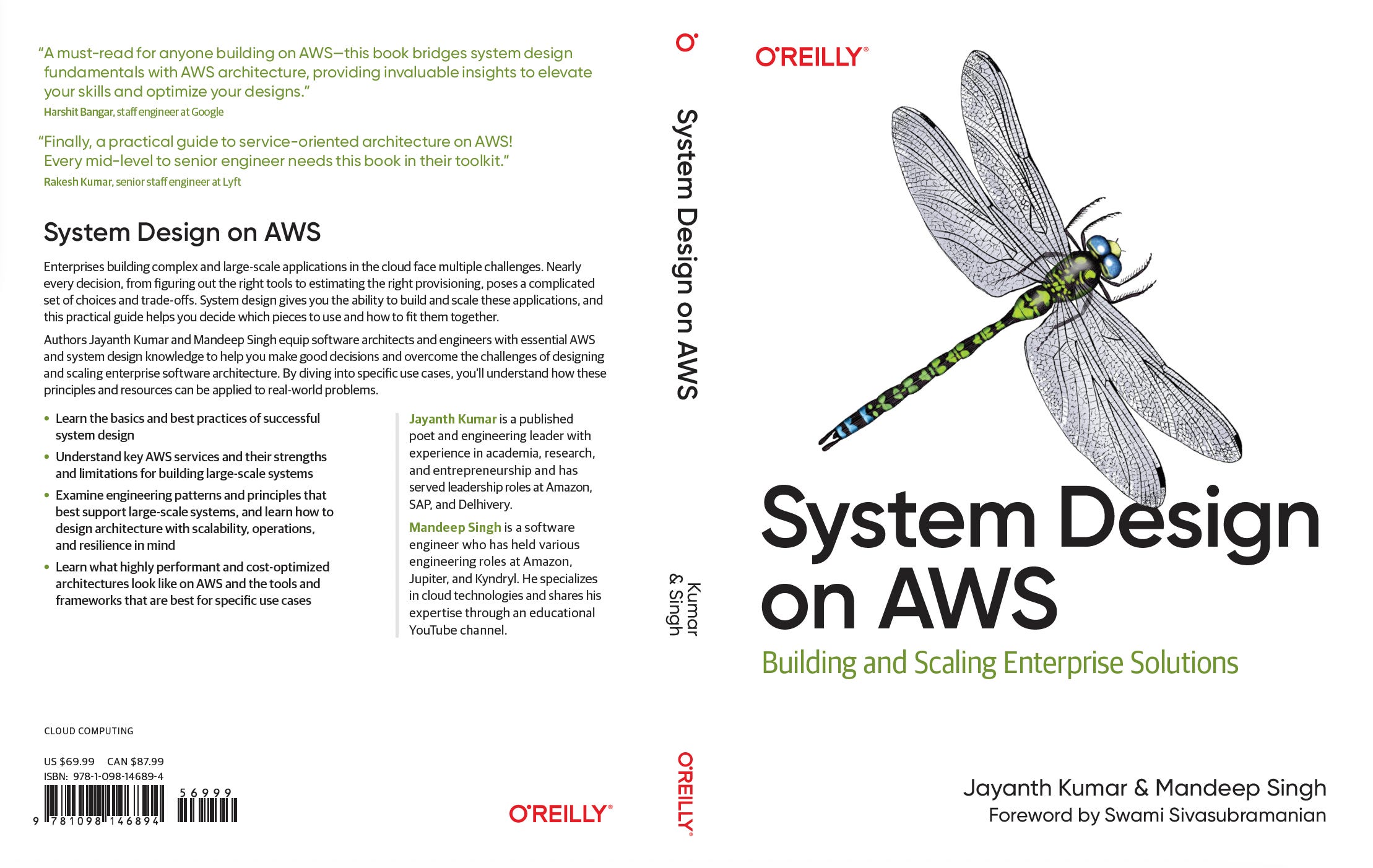
Let’s talk a little about the book I wrote with O’Reilly - System Design on AWS.
System Design on AWS
System Design on AWS was written with a clear philosophy: to be useful both “during the interview and after the interview.” It is designed to take your knowledge beyond basic whiteboard theory so you can make effective long-term architectural decisions when building actual products.
Book Content
Part 1 - Fundamentals: Covers core distributed building blocks like load balancers, caching layers, databases, network protocols, containerisation and general architecture patterns.
Part 2 - AWS Services: Maps out the specific AWS services available across different operational domains (compute, databases, networking, event-driven, observability, big data, machine learning etc.).
Part 3 - Practical Implementation: Focuses on real-world system design philosophy. It walks through building complex applications from scratch such as a stock broker platform or a hotel reservation system. From gathering initial requirements to deploying the actual AWS components. It emphasizes that drawing boxes on a whiteboard is not enough; you need to know how to actually run the system.
You can find everything about the book on https://msdeepsingh.com/books/
Get System Design on AWS
📕 O’Reilly: https://learning.oreilly.com/library/view/system-design-on/9781098146887/
📕 Amazon.in: https://amzn.to/4jExkte
📕 Amazon.com: https://amzn.to/3D3BIBJ
📕 Amazon.co.uk: https://amzn.to/3QW6Fvf
📕 Shroff Publishers (Indian Subcontinent): https://www.shroffpublishers.com/books/9789355428035/
Before closing, I want to share my opinions on the choice of publisher.
Self Publishing or Publishing House?
Self publishing means you’re already well-known in the industry and people will buy the book looking at your name as author. If you’re a first time author like me, you’ve to give some reason to readers so they can trust you. O’Reilly solved this problem for me. O’Reilly is a trusted name and they don’t publish random jargon, the book goes through a strict process so readers clear the first barrier of buying the book.
Also, we were not aware of the overall process. You’ve to spend some additional time on marketing, content reviews, copy editing, etc which are taken care of by O’Reilly in-house. Given we both had full time jobs, O’Reilly was the preferred choice and I’m very glad we pursued this project.
On a closing note, writing a technical book may not make you a millionaire, but it will sharpen your communication, expand your professional network and strengthen your domain expertise.
Best of Luck!!!
You can reach out to me on LinkedIn for specific queries.